
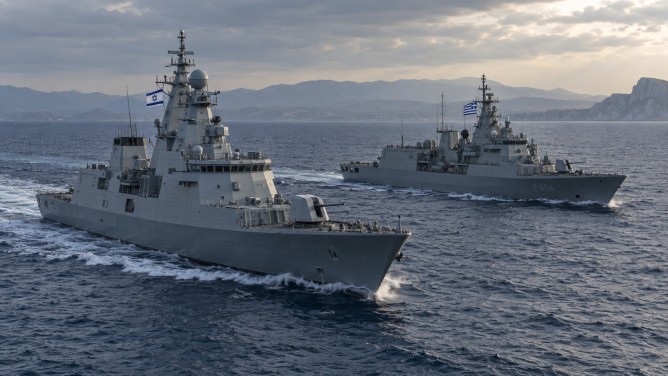
The Israeli and Greek navies have recently carried out a joint military exercise in the Mediterranean Sea aimed at bolstering defense cooperation amid escalating regional tensions. This collaboration comes in light of disagreements over maritime boundaries involving Türkiye, highlighting the strategic importance of naval alliances in the region.
The exercise featured Israeli missile boats and several Greek naval units, with leadership from Israeli Navy Chief Vice Admiral Eyal Harel and his Greek counterpart, Vice Admiral Dimitrios-Eleftherios Kataras, along with senior Greek defense officials. Throughout the drill, the navies engaged in various operational scenarios, such as identifying maritime threats, coordinated sailing, and executing missile attacks on a simulated enemy vessel.
The Israeli military emphasized the significance of this exercise as a step towards enhancing operational coordination, joint readiness, and ensuring freedom of navigation in the Mediterranean. Vice Admiral Harel remarked that the partnership with Greece would improve both nations’ capabilities to operate together in support of regional security.
This drill was conducted shortly after Libya and Türkiye ratified a controversial maritime-boundaries agreement, which Israel and Greece oppose. The agreement has intensified existing regional disagreements over maritime rights and influence in the eastern Mediterranean.
In recent years, defense ties between Israel and Greece have grown stronger as both countries seek to deepen their security cooperation. Meanwhile, relations between Israel and Türkiye have deteriorated significantly, primarily due to tensions over the war in Gaza and Turkish President Recep Tayyip Erdoğan’s criticisms of Israeli policies.
The joint naval exercise underscores the increasing importance of maritime security and cooperation among regional powers as they navigate complex strategic interests in the Mediterranean.