
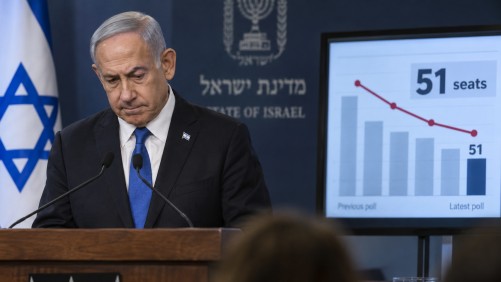
As Israel approaches its next election on October 27, political uncertainty looms with no clear majority in sight, according to a recent poll. The survey indicates that Prime Minister Benjamin Netanyahu’s bloc would secure 51 seats in the 120-member Knesset, while the main Zionist opposition bloc is projected to win 55 seats. This leaves both sides short of the 61 seats needed for a parliamentary majority, setting the stage for complex coalition negotiations.
The poll suggests that two Arab-majority parties, expected to win a combined total of 14 seats, could play a pivotal role in the formation of a new government. With no single party or bloc able to secure a decisive lead, these parties may become crucial in coalition-building efforts.
In terms of individual party performance, the Yashar party led by former IDF chief Gadi Eisenkot is positioned as the largest party with an estimated 24 seats. Meanwhile, Naftali Bennett’s B’Yachad is projected to garner 14 seats, Yisrael Beytenu nine, and the Democrats eight. Within Netanyahu’s coalition, Likud is forecasted to receive 22 seats, Shas 10, United Torah Judaism nine, Otzma Yehudit seven, and Religious Zionism four.
Several smaller parties, including Ofer Winter’s People of Israel, HaMiluimnikim, and Blue and White, failed to meet the 3.25% electoral threshold required to enter the Knesset. This threshold continues to pose a challenge for lesser-known parties seeking representation.
Should the election result in another deadlock, public opinion remains divided on the next steps. The poll indicates that 31.4% of respondents would prefer another election, 29.6% support a unity government, and 27% favor a minority government. Among Netanyahu’s supporters, 45.02% advocate for a unity government, contrasting with 39.79% of his opponents who favor a minority government.
The survey, which involved 500 respondents and carries a margin of error of 4.4 percentage points, underscores the prevailing unpredictability in Israel’s political landscape as the election date approaches.