
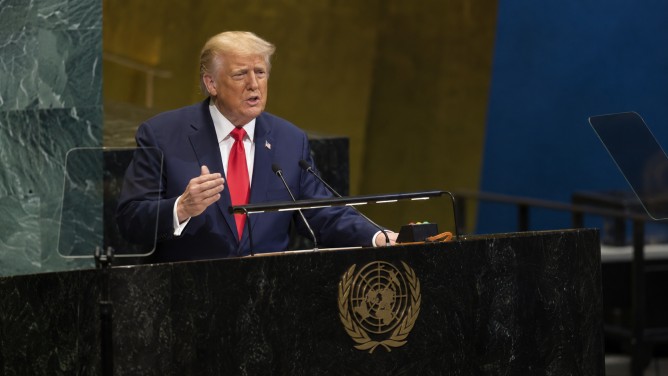
The ongoing tensions between the United States and Iran have dominated international discourse, with economic and geopolitical ramifications that reverberate through critical regions like the Strait of Hormuz. Against this backdrop, US President Donald Trump is poised to address the United Nations General Assembly, where he is expected to defend his administration’s military actions against Iran and emphasize efforts to resolve the Gaza conflict.
In his speech, Trump is anticipated to argue that the policies implemented by his administration have bolstered the United States’ global standing. He will likely portray himself as a leader striving to balance military assertiveness with diplomatic negotiations. This appearance comes amid continuous concerns over the stability of the region, particularly the strategic maritime passageway at the Strait of Hormuz, which is vital for global oil transportation.
Additionally, Trump’s address is expected to highlight his administration’s initiatives aimed at resolving the ongoing conflict in Gaza. His proposals reportedly include measures for the disarmament of Hamas and the reconstruction of the area, although significant progress remains elusive. The address provides Trump a platform to articulate his stance on these complex issues amid a challenging international landscape.
Trump’s visit to New York for the UN General Assembly includes scheduled meetings with various foreign leaders, such as Ukrainian President Volodymyr Zelenskyy and Japanese Prime Minister Sanae Takaichi. These diplomatic engagements underscore the broader context of international relations that the US is navigating during his presidency.
Meanwhile, UN Secretary-General António Guterres is expected to open the assembly with remarks focusing on global conflicts and the rapid evolution of artificial intelligence, setting the stage for discussions on pressing global challenges. The assembly serves as a significant forum for world leaders to address critical issues and seek collaborative solutions.